
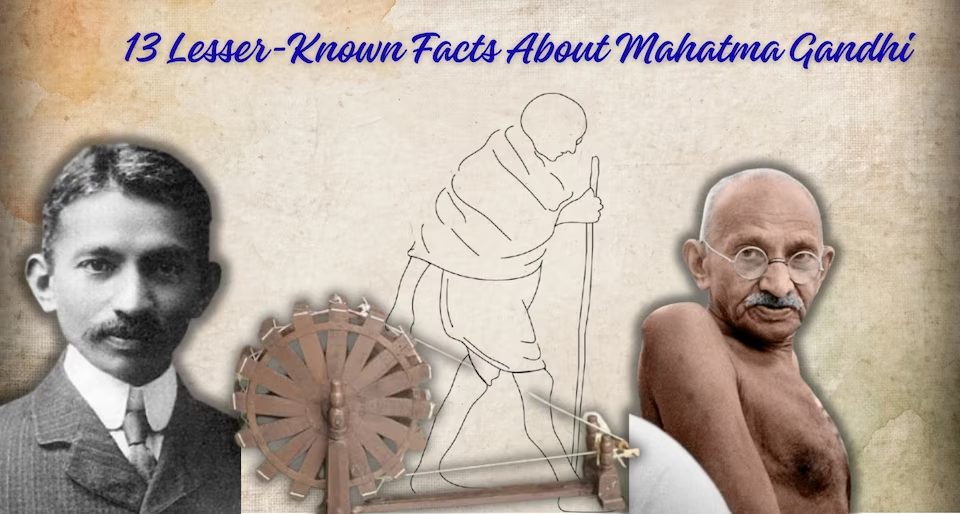
Mahatma Gandhi is one of the most written-about people in history. Yet most of what we know about him comes from a handful of repeated stories — the Salt March, the spinning wheel, and the famous warning that “an eye for an eye” would leave the whole world blind. These are familiar, but they are also just the surface.
Dig a little deeper into his life, and you find a far stranger, more human, more contradictory man. Here are 13 lesser-known facts about Mahatma Gandhi.
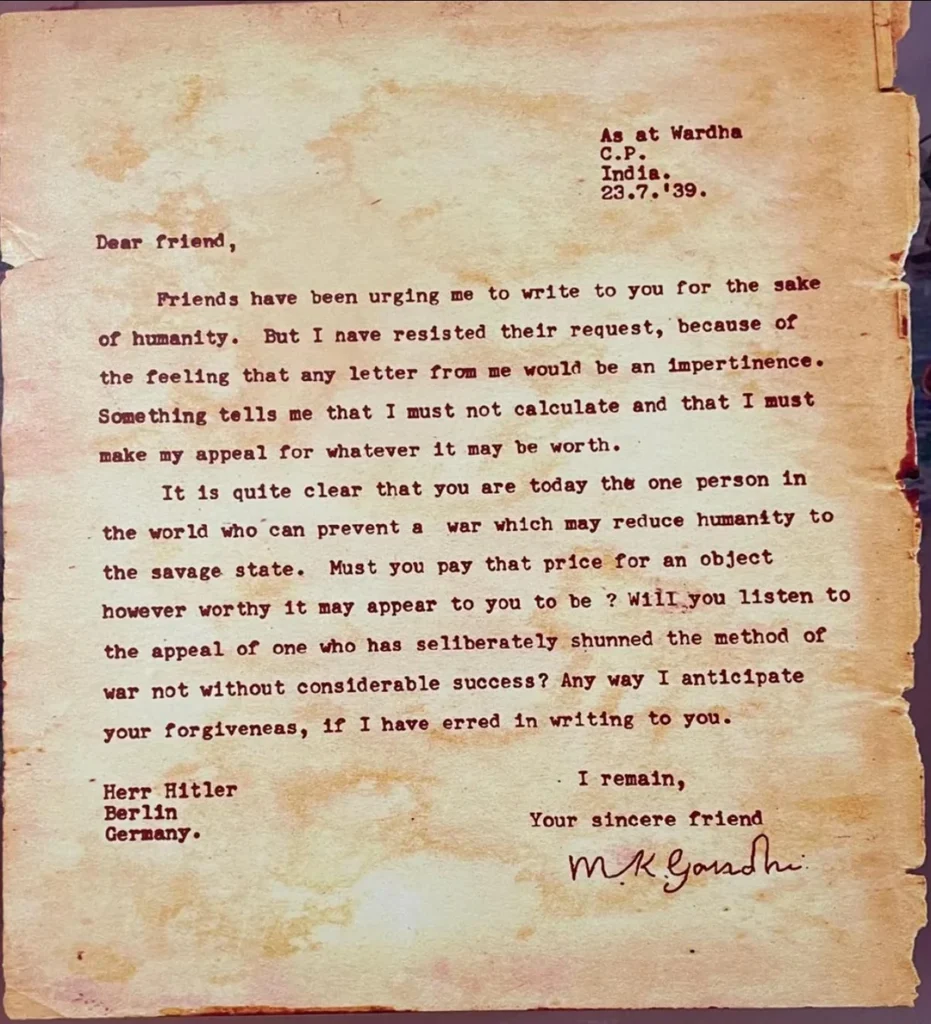
He wrote a letter to Hitler calling him “my dear friend”
In 1939, as Europe stood on the edge of war, Gandhi picked up his pen and wrote to Adolf Hitler. He opened the letter with the words, “Dear Friend.” He explained that friends had urged him to write “for the sake of humanity” and appealed to Hitler to prevent a war that could reduce humanity to a “savage state.” Gandhi wrote to Hitler again in 1940.
The striking part isn’t just that Gandhi wrote to Hitler, but that he deliberately addressed him in such remarkably personal terms while attempting to persuade him to abandon war and violence.
He wasn’t in Delhi when India became free
On August 15, 1947, while Jawaharlal Nehru delivered his famous “Tryst with Destiny” speech in Delhi, Gandhi was in Calcutta. He chose not to participate in the independence celebrations, instead devoting his time to prayer and efforts to stop the horrific communal violence accompanying Partition.
For Gandhi, independence had arrived wrapped in tragedy. While much of India celebrated freedom, he was focused on trying to prevent Hindus and Muslims from killing one another.
He wanted to shut down the Congress party
A day before he was assassinated in January 1948, Gandhi was working on a draft constitution — not for India, but for the Indian National Congress. His idea was radical: the Congress, having achieved independence, had outlived its original purpose as a political organisation and should be transformed into a social-service organisation.
His draft, dated January 29, 1948, proposed converting Congress into a body devoted to public service rather than continuing as a political machine.
His assassination the following day meant that the proposal never became Congress policy.
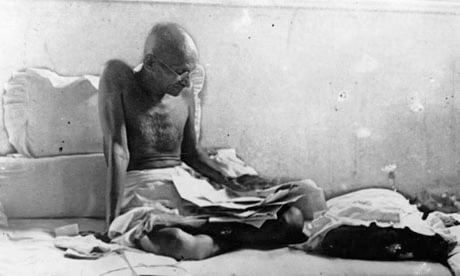
The British restricted photographs of him during some hunger strikes
Gandhi went on hunger strikes many times throughout his life, some lasting weeks. During some of these fasts, British authorities restricted the publication of photographs showing his emaciated condition, particularly because such images could generate sympathy for Gandhi and opposition to colonial rule.
The restrictions were not a blanket ban on every photograph of Gandhi during every fast. But British authorities clearly understood the political power of images of the fasting Gandhi and attempted, on some occasions, to control their circulation.
His milk vow had a loophole
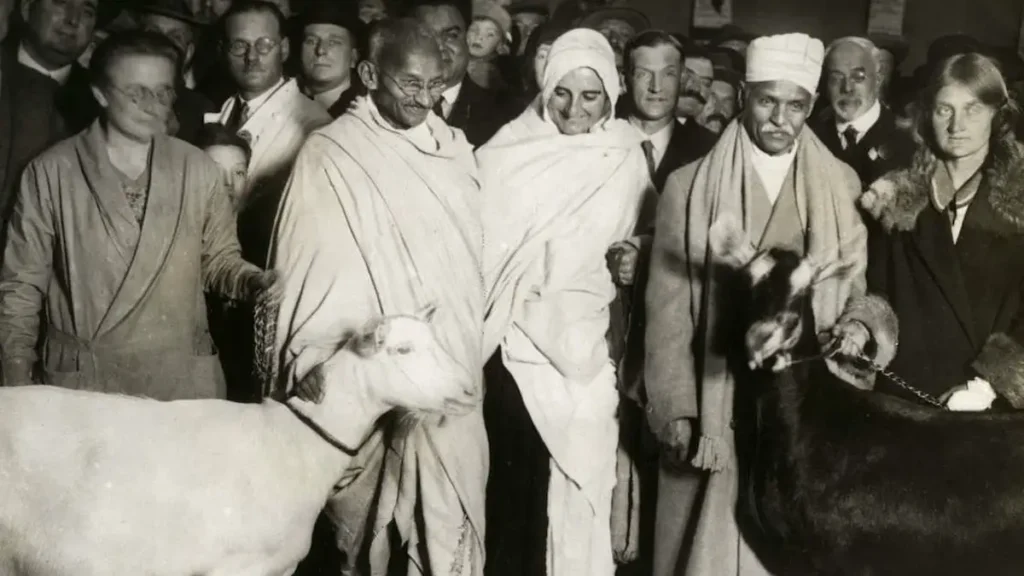
Gandhi took a strict vow never to drink milk from cows or buffaloes. This came from his disgust at phooka, a cruel practice used by some milkmen to force more milk out of animals.
But years later, his health began to fail, and he was persuaded to take milk. Kasturba pointed out that his vow specifically concerned cow and buffalo milk — it said nothing about goats. Gandhi therefore began drinking goat’s milk.
The fascinating part is that Gandhi himself acknowledged the problem: he knew he was adhering to the letter of his vow rather than its spirit.
He spent about five years on a fruit-and-nut diet
For about five years, Gandhi experimented with a fruitarian diet, eating fruits and nuts while avoiding milk and cooked food. This wasn’t simply about vegetarianism — it was part of his lifelong experiments with health, self-discipline and diet.
Gandhi wrote that during this period he did not feel weak or suffer from disease, so it would be misleading to say that the five-year experiment itself left him seriously unwell. Instead, it is better understood as one of the many dietary experiments he conducted throughout his life.
Some of his ashes travelled surprisingly far
After Gandhi’s cremation, portions of his ashes were taken to different places for immersion. Some remained in India, while others travelled abroad.
One particularly strange story involved an urn said to contain Gandhi’s ashes that had been deposited in a bank vault in Cuttack in 1950. The urn remained there for decades and eventually became the subject of a Supreme Court case. The court record described the box as containing an urn stated to contain Gandhi’s ashes.
In 1997, Gandhi’s great-grandson Tushar Gandhi received the urn, and its contents were subsequently immersed at the Triveni Sangam in Allahabad (now Prayagraj).
Other portions of Gandhi’s ashes also travelled outside India. One portion was taken to Uganda and immersed at the Source of the Nile at Jinja in 1997.
So the remarkable story isn’t that an urn is still sitting forgotten in a Cuttack bank vault — it isn’t. The real story is that an urn deposited there in 1950 remained undiscovered for decades before eventually being recovered and immersed.
He organised medical corps for the British — twice
Long before he became the face of Indian resistance against British rule, Gandhi organised and led ambulance or stretcher-bearer units serving with British forces.
He did this during the Boer War in 1899 and again during the Zulu uprising in 1906, helping transport and treat wounded men.
Calling this “serving in the British army” is technically misleading: Gandhi was not a combat soldier. He organised medical support units. But it remains a fascinating contradiction in the life of a man who would later become one of history’s most famous opponents of colonial rule.
He was nominated for the Nobel Peace Prize five times — and never won
Gandhi was nominated for the Nobel Peace Prize in 1937, 1938, 1939, 1947 and 1948. He never received the award.
The Nobel organisation itself has since publicly regretted the omission. When the Dalai Lama received the Peace Prize in 1989, the chairman of the Norwegian Nobel Committee said that the award was, in part, a tribute to Gandhi’s memory.
Gandhi remains one of the most famous figures to have been nominated repeatedly without ever receiving the prize.
“Mahatma” was a title, not his name
Gandhi’s actual name was Mohandas Karamchand Gandhi.
The word Mahatma, meaning roughly “Great Soul,” was an honorific. Rabindranath Tagore is traditionally credited with popularising the title, but there is no conclusive evidence that he was the first person to use it for Gandhi.
Even the Government of India’s Gandhi Smriti material notes that there is no definitive evidence establishing who first called Gandhi “Mahatma.”
The title eventually became so closely associated with him that “Mahatma Gandhi” is now how he is known around the world.
His first day in court was a disaster
Gandhi trained as a barrister in London and returned to India fully qualified to practise law. But his first real courtroom experience in India reportedly went badly.
In his autobiography, Gandhi described appearing in a Bombay court and becoming so nervous when it was time to cross-examine a witness that he couldn’t think of a single question. He eventually sat down and returned the client’s fee.
The man who would later confront the might of the British Empire was, at the beginning of his legal career, so nervous in court that he could barely speak.
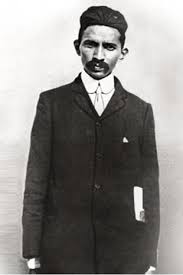
A Russian novelist shaped his philosophy
While Gandhi was living in South Africa, he began corresponding with the great Russian writer Leo Tolstoy. Gandhi had already been influenced by Tolstoy’s writings, particularly his ideas about nonviolence, conscience and resistance to evil without resorting to violence.
Their correspondence, in the final years of Tolstoy’s life, further influenced Gandhi’s thinking.
Gandhi respected Tolstoy so much that he named a commune he established in South Africa Tolstoy Farm in his honour.
His celibacy experiments were deeply controversial
In his 70s, Gandhi carried out unusual personal experiments to test his self-discipline, as part of his lifelong commitment to brahmacharya, or celibacy.
These experiments included sleeping beside young women, including female relatives and followers, while unclothed. Gandhi regarded such practices as tests of his ability to maintain sexual self-control.
The experiments were controversial even among people close to him. Nirmal Kumar Bose, one of Gandhi’s associates, expressed serious concerns about the psychological implications of the practice. Jawaharlal Nehru also disagreed with aspects of Gandhi’s ideas about sexuality and celibacy.
These episodes remain among the most controversial and debated aspects of Gandhi’s life, and historians continue to interpret their meaning differently.
Gandhi’s life doesn’t fit neatly into the image of the saintly figure we usually see in photographs and postage stamps. He was a man of deep contradictions — a medical volunteer who later led an anti-colonial movement, a strict vow-keeper who admitted to exploiting a loophole, a global icon who spent India’s Independence Day away from the celebrations, and a political leader who ultimately wanted the Congress organisation transformed into something very different.
Understanding these smaller, stranger and sometimes uncomfortable details doesn’t necessarily take away from his legacy. If anything, they make him more human — and give us a more complicated picture of one of the most influential figures of the 20th century.
References
- Selected Letters of Mahatma Gandhi — Letter to Adolf Hitler, July 23, 1939. Gandhi Research Foundation / mkgandhi.org.
- Draft Constitution of Congress, January 29, 1948. Cambridge University Press, Gandhi: Hind Swaraj and Other Writings.
- Tushar Arun Gandhi vs. State of Orissa & Others, Supreme Court of India, November 26, 1996 — concerning the urn deposited in Cuttack.
- Mahatma Gandhi, the Missing Laureate. NobelPrize.org.
- Nobel Prize Nomination Archive — Mahatma Mohandas Karamchand Gandhi. NobelPrize.org.
- The Story of My Experiments with Truth — Gandhi’s autobiography, including his accounts of diet, milk and his early legal career.
- Gandhi Smriti — Frequently Asked Questions, Government of India — information concerning the title “Mahatma.”
You may also like these:
9 Most Heionous Criminals in Ancient History
The Aryan Invasion Theory: A lie taught for years in history books?