
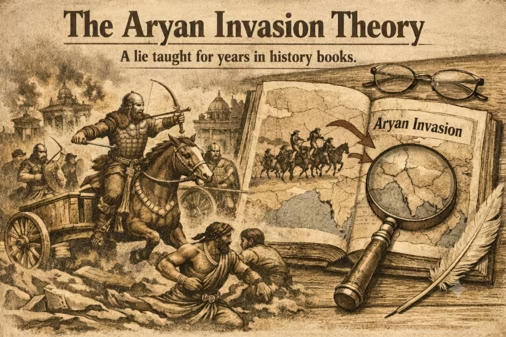
Are Aryans foreign invaders? Is Vedic culture, including Sanskrit, an imported thing? Was India a barbarian land populated by natives which prospered only after intellectual people called Aryans from the west came here?
We have been taught in our history books for ages that Aryans came from outside of India (near the Caucasus mountain region), causing unbearable pain to native people called Dravidians, and that Aryans were from a superior race with fair skin and blue eyes, while native Dravidians were dark-skinned people not very advanced in their warfare. The irony is that there has been no archaeological or genetic evidence supporting this theory. Yet, we kept believing in this propaganda for hundreds of years without questioning this fictional theory. This blog is an attempt to debunk the lie propagated over the years by the proponents and supporters of the so-called “Aryan Invasion Theory“.
What is “The Aryan Invasion Theory”?
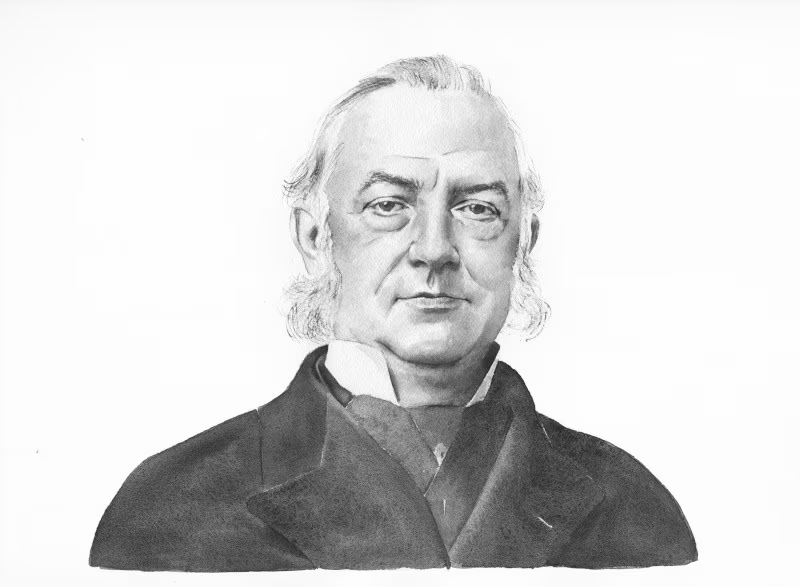
In simple words, the Aryan Invasion Theory states that the Vedic people were not indigenous to Indian land and that they migrated from the Caucasus Mountain region around 1500 BCE. They invaded native Dravidian people and conquered them. These people, called Aryans, wrote Vedic literature and imposed it on the natives. This theory was popularised by philologist Max Müller in the mid-19th century (we’ll discuss his motives later). He leveraged Sir William Jones’s linguistic study to gain support for his propaganda. In 1786, Sir William Jones noted linguistic links between Sanskrit, Greek, and Latin, suggesting a shared Indo-European language root. Max Müller used this to propose that Aryans were not just a language family, but a race with roots in the west.
Later, during excavations at Mohenjo-daro, it was discovered that approximately 33 to 37 human skeletons were scattered in streets and rooms rather than properly buried in a cemetery. British archaeologist Sir Mortimer Wheeler, who was the Director-General of the Archaeological Survey of India (ASI) in 1944, proposed that nomadic Aryans invaded the native people of the Indus Valley Civilisation and massacred them, resulting in the sudden collapse of the civilisation. With little knowledge of Indian texts, he also misinterpreted the Rigveda to support his claim by referring to Indra, who was called Purandara, which translates to “Destroyer of the Forts.” He very conveniently concluded that Indra was the one who destroyed the Indus Valley Civilisation.
With all this, the latest narrative became that Aryans were nomadic people from Central Asia/Eastern Europe who attacked native Indian people, destroyed the Indus Valley Civilisation, and imposed Vedic literature on them. British educationists and intellectuals used this theory to alienate Indian people from their glorious past and create a divide among Indians in the name of Aryans and Dravidians, upper class and lower class, etc.
| “Their conclusions would permit them to regard the ancient rishis as primitive men inferior to the moderns… their analysis of our religious texts was motivated by the desire to show Christianity as a better religion.” – Chandrasekharendra Saraswati |
Macaulay’s motive and Max Müller
The British Raj faced a tough test during the first structured Indian National Movement in 1857. They realised that it was impossible to rule over India just by force and wars unless they colonised the minds of Indian people as well. Indians cherished and took pride in their glorious past, which was a common link that kept the whole of India united in its movements against the British. Lord Macaulay was tasked by the British government as the Chairman of the Education Board to serve this purpose. Macaulay built a plan to transform the Indian education system to nurture a new breed of English-educated Indians who would be alienated from their texts, align better with the west, and become collaborators of the British government.
Macaulay firmly believed that the conversion of Indian people to Christianity was essential because religious conversion and colonialism go hand in hand.
His motive is clear from a letter he wrote to his father:
“Our English schools are flourishing wonderfully. The effect of this education on the Hindus is prodigious… It is my belief that if our plans of education are followed up, there will not be a single idolater among the respectable classes in Bengal thirty years hence…..”
All this would not happen unless Hindus, especially the Brahmanas, gave up their strong and age-old belief in Vedic literature in favour of Christianity. Macaulay persisted for many years until he was able to secure funds for translating Vedic texts into English. The agenda was clear: misinterpret Indian texts written in Sanskrit to prove that the base of Indian religious beliefs is not modern, is oppressive, and is much inferior to western beliefs.
Macaulay was able to convince the East India Company to secure funds to translate the Rigveda as an initial step towards a bigger conspiracy. The British East India Company (a proxy for the British Raj) recruited German scholar Max Müller for this purpose. Max Müller was a devout Christian who was going through financial hardship and desperately needed the job.
It is clear from his letter to his wife that he was a British-paid agent with a special motive:
“It [the Rigveda] is the root of their religion and to show them what the root is, I feel sure, is the only way of uprooting all that has sprung from it during the last three thousand years.”
Müller himself later retracted his Aryan race concept and described Aryans in linguistic rather than racial terms: “I have declared again and again that if I say Aryan, I mean neither blood nor bones, nor skull nor hair; I mean simply those who speak the Aryan language…”
Note that the Aryan race theory popularised by Müller was used by Hitler and his Nazi regime to justify racial genocide against Jews by establishing that the Aryan race was the purest race and that Germans were essentially Aryans.
“These special conditions were the rise of Nazism in Germany and British imperial interests in India. Its perversion in Germany leading eventually to the Nazi horrors is well known. The fact that the British turned it into a political tool to make their rule acceptable to Indians is not generally known.” – N. S. Rajaram |
| A BBC report – 6 October, 2005: “It [Aryan Invasion Theory] gave a historical precedent to justify the role and status of the British Raj, who could argue that they were transforming India for the better in the same way that the Aryans had done the same way thousands of years earlier”. Original BBC article has been removed now, but you can still read it here. |
Arguments debunking the theory
No proof of Aryan Invasion
Mortimer Wheeler’s theory hinting at an Aryan invasion based on the skulls found in Mohenjo-daro holds no ground. As archaeologist B. B. Lal noted, calling the presence of a few skeletons a sign of massacre is purely illogical. Lal mentions that the skeletons were found at different stratigraphic levels. If it were a massacre, all would have been found at one level. The Aryan Invasion Theory assumes that the invasion happened around 1500 BCE, but a study of human skeletal remains by Hemphill and his colleagues in 1991 proved that no new people arrived between 4500–800 BCE. Then how could the invasion have happened in 1500 BCE?
It is understood that Vedic texts, before being written down, were preserved through generations orally. It would be impossible for nomadic people to preserve knowledge this way (as the Aryan theory claims Aryans were nomadic). Furthermore, if Aryans had such rich texts, language, and culture, why didn’t they leave a trace of them in the places they supposedly migrated from?
Also, Aryans had such rich texts, language and culture, why did they not leave trace of all these in the places where they migrated from?
Flora and fauna mentioned in this Rigveda belong to a tropical climate.
Dr B.B.Lal states – “Let it be squarely stated that the earliest book of the Aryans, the Rig Veda, does not mention any of the species of cold-climate trees enumerated. On the other hand, all the trees mentioned in the Rig Veda, such as the Ashvatha (Ficus religiosa L.), Khadira (Acadia catechu Wild), Nigrodhas (Ficus benghalenis L.), do not belong to a cold climate but to a tropical one. Likewise, the Rig Vedic fauna, comprising such species as the lion, elephant, peacock, also belong to a tropical climate…..it squarely follows that the Rig Vedic people were indigenous.”
The “no horse in Harappa” logic doesn’t hold
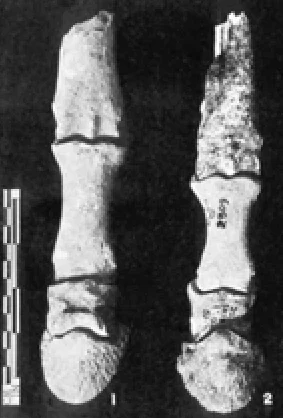
One more logic supporters of this theory give is that no horse remains have been found in Harappa whereas Vedic texts mention horses extensively so Indus Valley civilisation and Vedic period can’t coexist at the same time. This argument doesn’t hold any value because there have been horse remains found from Mohen-jodaro, Harappa, Lothal, Ropar, Surkotada, Kalibangan, Rangpur, Malvan, Bagor and Mahagara (near Allahabad) which are carbon-dated to as old as 4500 BCE— thousands of years before any proposed invasion.
Misleading argument based on urban vs rural society
Another logic supporters of the theory give that Harappan civilization was an urban one whereas Vedic people were cattle-herding pastoralists having a rural society. This logic treats urban and Vedic as mutually exclusive categories. Any society like in today’s date, don’t just have urban or rural structure rather they are mix of it. Same thing would apply to Harappan civilisation as well, it would have advanced urban society as well as rural settlements and same would hold for Vedic society. So just based on the rural-urban debate, one can’t justify that Indus Valley civilization wasn’t a Vedic one.
Dr B. B. Lal notes that the Harappan world contained cities, towns, and villages side by side, exactly as Vedic society did.
Archaeologist S. P. Gupta makes the same point from the literary side: “the Vedic texts themselves show clear awareness of cities, city life, and long-distance overland and overseas trade, which makes far more sense if the Vedic and Harappan worlds were simply two faces of one civilization rather than two unconnected ones.“
Hypothetical dates by Max Müller
Max Müller was so clouded by his Christian beliefs that he assigned a random year of 1500 BCE for Aryan Invasion. As per the Christian beliefs, world was created around 4000 BCE. Müller could not believe anything would have existed before 4000 BCE, so he assigned 1500 BCE as Aryan Invasion and 1200 BCE as the year when Rigveda was written. But did he have any logic to back it up? – No.
Later Müller himself accepted the arbitrary nature of these dates – “I need hardly say that I agree with everyone of my critics. I have repeatedly dwelt on the entirely hypothetical character of the dates that I venture to assign [to the Vedic literature]. … Whether the Vedic hymns were composed 1000, 1500 or 2000 or 3000 BC, no power on earth will ever determine.”
The context of the Saraswati river
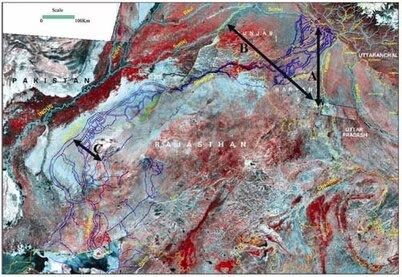
Based on the latest research through earth sensing satellite technologies, it has been established that Saraswati is not a hypothetical river. It not only existed during the Vedic period, it was at its prime during those days. Rigveda mentions Saraswati 60 times. It describes Saraswati as she is the holiest and greatest of all rivers, the best of the seven rivers, and Mother of the rivers and the Sindhu River. The Rig Veda also indicates where the location of Sarasvati by placing it between the Yamuna and the Shutudri (modern Sutlej).
The satellite images from 1978 by ISRO (Indian space and research organisation) show that Saraswati was a channel which was 6-8 km wide and at some places upto 14 kms wide. Aerial survey by American Landsat satellite in 1990 showed a dried tract of 1000 miles where the Sarasvati would have flowed from the Himalayas to the western coast. Refer ISRO document – Page 5.
Geologist Sir Auriel Stein concluded that there indeed such a river existed which dried up when Sutlej changed it’s course.
Why are we talking about Saraswati here? Because, demise of Saraswati debunks the hypothetical year of 1500 BCE chosen as year of Aryan Invasion by Max Müller. Based on the evidence of archeology, hydrology and radiocarbon dates it is proven that the Sarasvati dried up around 2000 BCE. If Saraswati dried up around 2000 BCE, then Rigveda would have been written much before 2000 BCE because Rigveda depicts Saraswati in it’s prime days not in dying days. That proves that Vedic people were in Indian land before 2000 BCE, then how did they invade India in 1500 BCE?
Kalibangan (part of Indus Valley civilisation) was abandoned around 2000 BCE as per radiocarbon dates. It is likely that Kalibangan was abandoned due to drying of the Saraswati river. All these point to the fact that, Harappan people were Vedic people and Aryans were no invaders.
Stephen Knapp has established in his book “Proof of Vedic Culture’s Global Existence” that – “the Harappan civilization was a part of the Vedic culture in the form of its continuance and diversity, or regional variations. In fact, the Rig Veda was already in existence before the Harappan Civilization came into its prime.”
| Vivekananda on this: “And what your European pundits say about the Aryans swooping down from some foreign land, snatching away the lands of the aborigines and settling in India by exterminating them, is all pure nonsense, foolish talk! In what Veda, in what Sukta do you find that the Aryans came into India from a foreign country? Where do you get the idea that they slaughtered the wild aborigines? What do you gain by talking such nonsense? Strange that our Indian scholars, too, say amen to them; and all these monstrous lies are being taught to our boys!… Whenever the Europeans find an opportunity, they exterminate the aborigines and settle down with ease and comfort on their lands; and therefore they think the Aryans must have done the same!… But where is your proof? Guess work? Then keep your fanciful ideas to yourself. I strongly protested against these ideas at the Paris Congress. I have been talking with the Indian and European savants on the subject, and hope to raise many objections to this theory in detail, when time permits. And this I say to you–to our pundits–also, ‘You are learned men, hunt up your old books and scriptures, please, and draw your own conclusions.” |
| Dayanand Saraswati on this: “No Sanskrit book or history records that the Aryas came here from Iran… How then can the writings of foreigners be worth believing in the teeth of this testimony.” |
| Jim Shaffer, a western archeologist on this (From the article The Indo-Aryan Invasions: Cultural Myth and Archaeological Reality): “Current archaeological data do not support the existence of an Indo-Aryan or European invasion into South Asia at any time in the pre- or protohistoric periods. Instead, it is possible to document archaeologically a series of cultural changes reflecting indigenous cultural development from prehistoric or historic periods… The Indo-Aryan invasion as an academic concept in 18th- and 19th-century Europe reflected the cultural milieu of that period. Linguistic data were used to validate the concept that in turn was usedto interpret archaeological and anthropological data. What was theory became unquestioned fact that was used to interpret and organize all subsequent data. It is time to end the ‘linguistic tyranny’ that has prescribed interpretive frameworks of pre- and protohistoric cultural development in South Asia.” |
Conclusion
The river chronology, archaeological records, and the genetic data, everything proves that the Aryan Invasion Theory is just a lie which was formulated to serve British colonial interests.
This theory has been thrown into the dustbin by most of the intellectuals now but the dent it has caused is long lasting. It has created North Indian-South Indian divide, high caste-low caste divide. Missionaries still use it to alienate people from Vedic traditions and persuade them for conversion. Young people raised with this idea are not able to connect themselves with ancient past and feel that their ancestors are invaders from the west. Certain political movements particularly in Tamilnadu are attaching a separate Dravidian identity to people of the state to reject Hinduism as Aryan.
We need to understand the differentiation among Indians in terms of their identity and roots are not real, they have been systematically pushed into our minds through a foreign propaganda.
Note for readers: The Aryan Invasion Theory has been discarded by most of the historians but a theory called “Out of India theory” which proposes that Aryans moved from India to west is also not well accepted despite some arguments given by nationalist historians. Alternate theory called “Aryan Migration Theory” has received wider acceptance which proposes that migration from west to east has happened as a slow process over the years. Even though this blog leans towards a nationalist view, it is important to validate the arguments and evidences of these theories before forming any strong opinion.
References:
G. P. Singh, Facets of Ancient Indian History and Culture
B. B. Lal, Origin of Indian Civilization, Edited by Bal Ram Singh
Max Muller, Biographies of Words and the Home of the Aryas
N. S. Rajaram, The Politics of History: Aryan Invasion Theory and the Subversion of Scholarship
B. B. Lal, The Home land of the Aryans, Evidence of Rig Vedic Flora and Fauna and Archeology
Stephen Knapp, Proof of Vedic Culture’s Global Existence
Jim Shaffer, The Indo-Aryan Invasions: Cultural Myth and Archaeological Reality
You may also like these: