
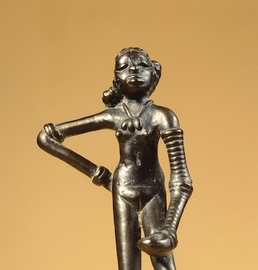
Recently, a controversy erupted over the bronze figurine known as the Dancing Girl of Mohenjo-daro where an obscured image of the Dancing Girl appeared in the NCERT Class 9 textbook Madhurima and later reverted to the original picture after a backlash. This article explores this controversy and other facts surrounding the whole issue.
What is the Dancing Girl of Mohenjo-daro?
Dancing girl is a bronze sculpture discovered in the ruins of Mohanjodaro (Present day Pakistan). It is among the most iconic artifacts discovered in the excavation of Mohanjodaro providing valuable insights into one of the world’s earliest urban civilizations – Indus Valley Civilization.
It is a bronze sculpture which was made around 2300-1750 BC during the Bronze Age in Mohanjodaro, one of the earliest cities of the Indus Valley Civilization (Also called, Harappan Civilization). It is a 10.5-centimetre-tall bronze statuette depicting a nude girl having one hand on her hip. The left hand has numerous bangles on it whereas the right one has just one bangle on it. The sculpture is made using lost-wax casting technique.
| Lost-wax casting is a metal casting technique in which a wax model of the sculpture is first created. The model is then covered with clay to form a mould. When heated, the wax melts away, leaving a cavity into which molten metal is poured. After cooling, the clay mould is broken to reveal the finished sculpture. To learn more refer here. |
Who discovered the Dancing Girl of Mohenjo-daro?
The Dancing Girl was excavated in 1926 during the excavations at Mohenjo-daro led by British archaeologist Ernest Mackay. John Marshall, then Director-General of the Archaeological Survey of India, later popularized the figurine by referring to it as the “Dancing Girl.”
Colonial Perspectives on the Dancing Girl
Several modern historians have argued that some colonial interpretations reflected the biases of their time. Rather than describing the figurine purely as an archaeological object, some British scholars interpreted it through the lens of contemporary Victorian morality and colonial assumptions. Ernest Mackay, a British archaeologist, even proposed that the figurine may have represented a temple dancer resembling the Devadasi tradition where he presented the hypothesis that the girl belonged to a sacred temple order. He suggested a cultural continuity between this ancient Harappan figure and the Devadasi system (hereditary temple dancers) found in later Hindu traditions across India.
Scholars like Upinder Singh have pointed out that projecting contemporary or medieval religious institutions (like the Devadasi system) onto a prehistoric, undeciphered culture from 2500 BCE is a major colonial assumption.
Since the Indus script remains undeciphered, historians have very limited evidence for identifying the occupation, social status, or religious role of the figure with certainty.
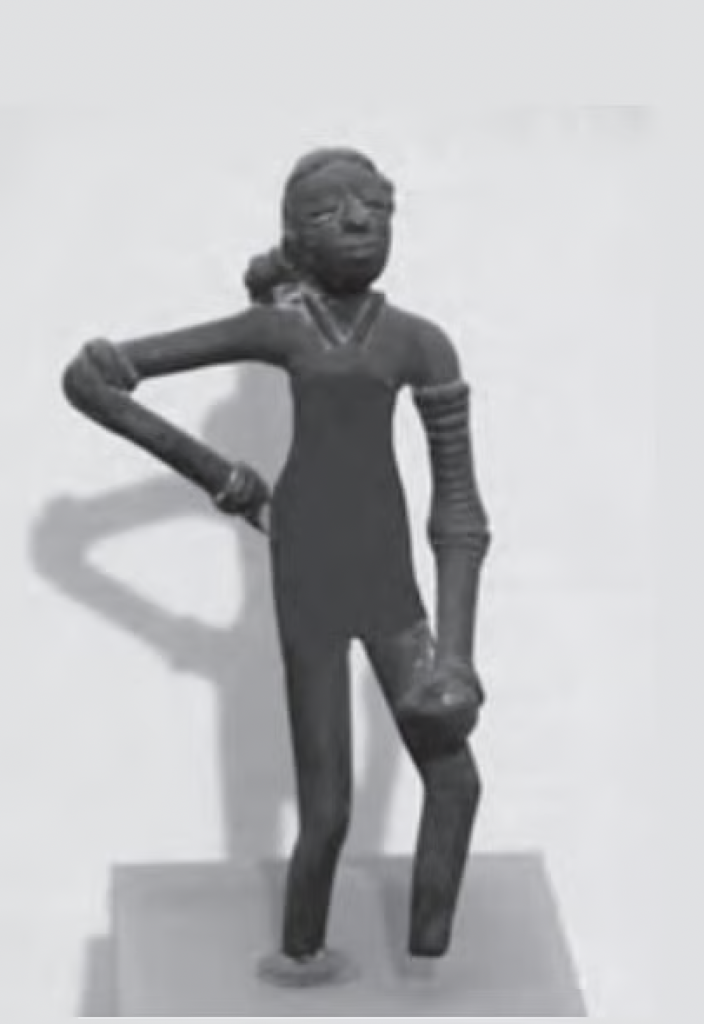
Pic: Picture of the dancing girl in the NCERT book which was later reverted
What is the controversy related to Dancing Girl of Mohenjo-daro with reference to NCERT?
The picture of the Dancing girl has been printed in NCERT books for many years without any alterations to it. It was observed in 2026 that the picture of the dancing girl in the book “Madhurima” is obscured in a way making it appear as though her torso had been covered.. It faced widespread criticism from historians, educators, artists, and archaeologists which resulted in NCERT reverting to the previous picture. Historian Michel Danino strongly criticized the edit, calling it an “act of censorship” and an “obsolete Victorian view” that compromised the authenticity of a historical artifact. NCERT cited it as an oversight rather than a conscious attempt to alter the content.
Conclusion
It is difficult to accept NCERT’s explanation that the alteration was merely an oversight, considering that textbooks typically undergo multiple rounds of editorial review before publication. Whether the alteration reflected editorial caution, moral sensibilities, or simply an editorial mistake remains open to debate. Since NCERT restored the original image without offering a detailed explanation, it is difficult to know whether the alteration reflected editorial caution, moral concerns, or simply an editorial oversight. In my opinion, the facts of history should be presented as is so that we know better about our past and culture. Moral standards are not constant across generations and countries, so having one scale for it is not justified. If historical artifacts begin to be modified to align with present-day moral sensibilities, the same logic could eventually extend to numerous monuments such as the sculptures at Khajuraho. Such an approach risks presenting a filtered version of history rather than history as it actually existed. Historical artifacts should be presented in their original form, allowing readers to interpret them for themselves.
What do you think about it? Let me know in the comments.
References:
Test you knowledge (MCQ)
| 1. During which historical period was the Dancing Girl of Mohenjo-daro created? A) Iron Age B) Bronze Age C) Neolithic Age D) Chalcolithic Age 2. Which metal casting technique was used to create the Dancing Girl figurine? A) Sand casting B) Centrifugal casting C) Lost-wax casting D) Die casting 3. In which year was the Dancing Girl figurine excavated? A) 1920 B) 1924 C) 1926 D) 1930 4. Who led the excavations at Mohenjo-daro where the Dancing Girl was discovered? A) Daya Ram Sahni B) R.D. Banerji C) John Marshall D) Ernest Mackay 5. What is the approximate height of the Dancing Girl statuette? A) 5.5 cm B) 10.5 cm C) 15.0 cm D) 20.5 cm 6. Which colonial-era tradition did Ernest Mackay suggest the Dancing Girl might be associated with? A) Sati system B) Devadasi system C) Caste hierarchy D) Guild system 7. Why do historians find it difficult to identify the precise religious or social role of the Dancing Girl? A) The figurine is too damaged B) There is no supporting archaeological evidence C) The Indus script remains undeciphered D) The statue was found in a private home 8. What was the specific nature of the controversy regarding the Dancing Girl in the NCERT textbook “Madhurima”? A) The image was removed entirely B) The image was replaced with a replica C) The image was obscured, making it appear as though the torso was covered D) The image was colorized and modified against historical facts 9. Who criticized the alteration of the Dancing Girl image, labeling it as an “act of censorship”? A) Ernest Mackay B) Upinder Singh C) Michel Danino D) John Marshall 10. Which major ancient civilization, often studied alongside the Indus Valley Civilisation, was located along the Nile River? A) Mesopotamian Civilisation B) Ancient Egyptian Civilisation C) Chinese Civilisation D) Mayan Civilisation Answer Key B (Bronze Age) C (Lost-wax casting) C (1926) D (Ernest Mackay) B (10.5 cm) B (Devadasi system) C (The Indus script remains undeciphered) C (The image was obscured, making it appear as though the torso was covered) C (Michel Danino) B (Ancient Egyptian Civilisation) |
You may also be interested in: Why Ashoka adopted Buddhism?