
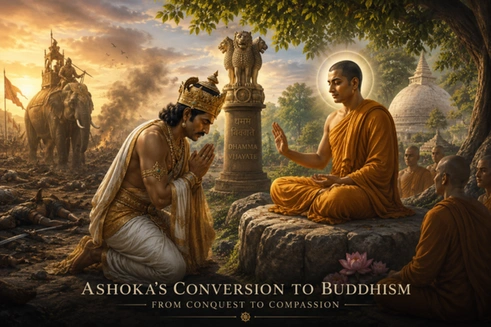
Which religion Ashoka followed before conversion to Buddhism?
Before we discuss on why Ashoka adopted Buddhism, it is important to know what Ashoka followed prior to conversion. Before embracing Buddhism, Samrat Ashoka was a devoted follower of Brahmanism (early Vedic traditions). Influenced by his family background, he was also closely tied to the Ajivika sect—an ascetic, non-Vedic philosophy followed by his mother, Queen Dharma—and he patronized various shramana (ascetic) and brahmana traditions.
The Mauryan emperors were known for their religious tolerance and patronage of multiple faiths. Historical records and his own edicts reveal the religious environment surrounding Ashoka early in his reign:
- Brahmanism: Ashoka’s father, Bindusara, was a follower of Brahmanism. In the early years of his rule, Ashoka followed non-Buddhist sects aligned with these traditional Vedic and Puranic practices.
- The Ajivika Sect: His mother, Queen Dharma, was a follower of the Ajivikas, a fatalistic and ascetic religious movement popular in ancient India. Ashoka maintained this tradition by granting caves and patronage to Ajivika monks in the early part of his reign.
- Diverse Patronage: Rather than enforcing a single state religion, Ashoka’s Dhamma was an ethical and social code. He continued to support various other traditions, including Jainism and Brahmanism, well after his conversion to Buddhism.
Historical sources which support Ashoka’s conversion to Buddhism
Emperor Ashoka’s conversion to Buddhism is primarily supported by two main categories of sources: contemporary inscriptions carved into rocks and pillars, and classical Buddhist chronicles.
The Edicts of Ashoka
The most definitive historical evidence comes from Ashoka’s own edicts. Carved onto rocks, boulders, and pillars across the Indian subcontinent (modern-day India, Nepal, Pakistan, and Afghanistan), these texts document his religious transformation:
- Minor Rock Edicts: The Minor Rock Edict No. 1, found at sites like Maski and Rupnath, provides the most direct evidence. In it, Ashoka explicitly states that he had been a lay follower (upasaka) of Buddhism for over two and a half years and that his zeal for the faith increased after he went to visit the Sangha (the Buddhist monastic order).
- Major Rock Edict XIII: This edict provides the context for his conversion, describing his profound remorse over the brutal Kalinga War. This realization caused him to abandon warfare and redirect his conquests to “Dhamma” (righteous conduct), prompting his gradual move toward Buddhism.
Buddhist Chronicles and Legends
Later literary and historical chronicles detail the events and specific figures surrounding his conversion, though they blend historical fact with legend:
- The Sri Lankan Chronicles: The Dipavamsa (Island Chronicle) and Mahavamsa (Great Chronicle) are critical sources. They state that Ashoka’s conversion was triggered by his young nephew, the monk Nigrodha, who recited the Buddhist teachings to him. These texts also name the monk Upagupta as the spiritual teacher who formally initiated the emperor into the Buddhist faith.
- The Ashokavadana: This text (part of the Sanskrit Buddhist canon) features the legend of Ashoka’s transformation. It tells the story of how he was converted by the elder Samudra and goes on to detail his patronage, which included building 84,000 stupas.
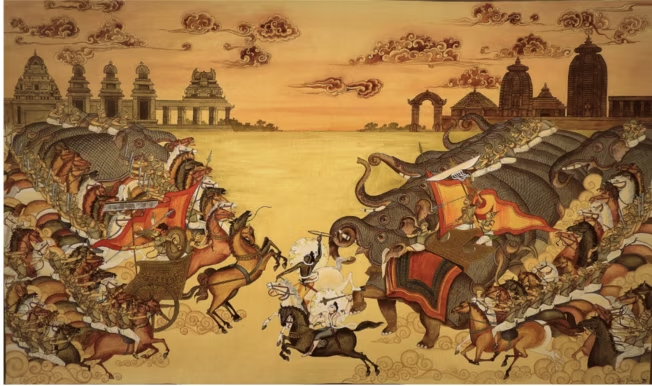
pic: The war of Kalinga
Conflicting theories in different sources
Based on Buddhist literature as well as rock edicts, it is evident that Ashoka eventually converted to Buddhism or at least he played a major role in propagating Buddhism across his empire. It should also be noted that even though he was a patron for Buddhism, he remained tolerant towards other traditions like Brahmanas and Ajivikas. My opinion is that Ashoka used Buddhist principles to diplomatically stitch together his empire without fighting any major war.
Based on rock edict XIII, Ashoka was so devastated by the casualties caused in the war of Kalinga that he chose a path of peace which was the reason for him leaning towards Buddhism.
If we are to believe Buddhist literature (Srilankan as well as Chinese), the war of Kalinga had no role to play in his conversion. Rather, he was so impressed with some Buddhist monks which made him change his mind to get into Buddhism. Chinese Buddhist text points to a theory where Ashoka was very annoyed with Brahamanas who were seeking alms regularly lacked manners and self-control. Point to note here is that there is no mention of the war of Kalinga in Buddhist texts.
Both of these theories are conflicting based on the chronology and dates mentioned there. Because Buddhist texts mention that he converted in the 4th year of his reign whereas rock edict XIII mentions 8th year of reign which is the possible year of his conversion. So it is hard to believe which theory is perfect. Widely accepted theory is that casualties of the war of Kalinga had a tremendous impact on his heart which led to his conversion.
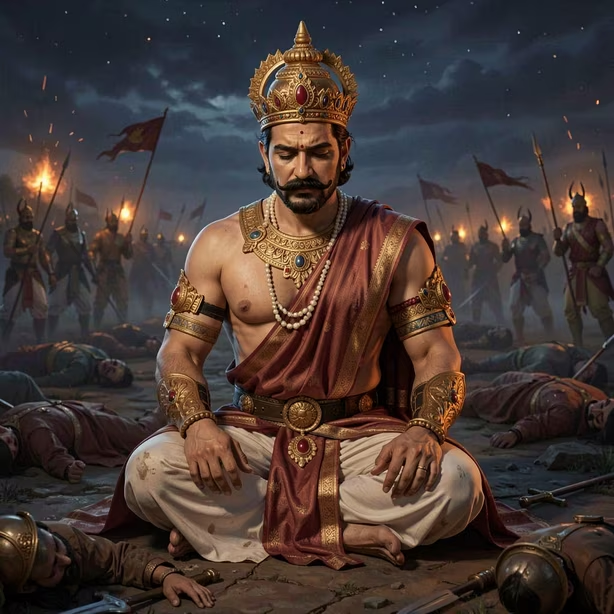
Who converted the King?
The Inscriptions: Ashoka takes full ownership of his spiritual journey, describing his remorse as a deeply personal awakening followed by a period where he drew closer to the Sangha (monastic community). No individual monk is ever credited with converting him.
The Chronicles: Different texts credit entirely different figures, fighting for the historical prestige of having converted the great emperor. The Sri Lankan Pali traditions heavily credit Nigrodha, while northern Sanskrit traditions (like the Ashokavadana) credit the monk Samudra or Upagupta.
Summary of the Historians’ Consensus
Because of these conflicts, modern historians generally conclude that Ashoka did not convert overnight because of Kalinga massacre. Instead, he was likely already a lukewarm lay Buddhist who used the immense guilt of the Kalinga massacre to rebrand his imperial policy from military expansion (bheri-ghosha) to moral governance (dhamma-ghosha).
What are your thoughts on this? Please let me know in the comments.
To explore the primary records and sites associated with his reign, utilize resources like the Archaeological Survey of India to track ancient stupas and pillar edicts located across the country.
If you still have questions on “Why Ashoka adopted Buddhism?”, you might refer to additional resource here.
If you want to learn about Indus Valley Civilization, check this.