
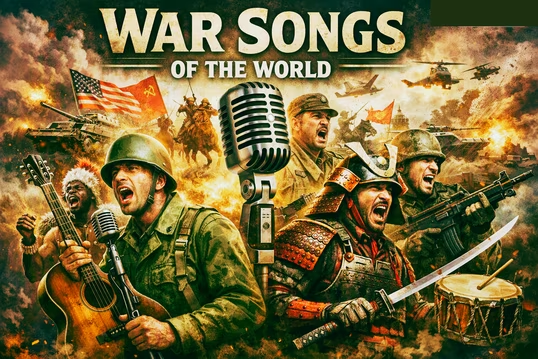
I’ve been down a strange rabbit hole lately — not battles or treaties, but the songs that came out of them. Because long before newsreels or TV cameras, music was doing the emotional heavy lifting of war. It rallied troops, comforted people back home, mourned the dead, and eventually, started asking uncomfortable questions about why any of it was happening in the first place.
Top 10 War Songs of the World. This list moves across about a century and a half of conflict — from the trenches of the First World War all the way to Vietnam, from brassy marching tunes to bitter protest songs that could barely stay in key with their own anger. There’s no single style holding these ten together, and honestly, that’s kind of the point. Each one just happened to be the right sound at the wrong moment.
“La Marseillaise” (France, 1792)
This one predates recorded sound entirely, which is wild to think about. Claude Joseph Rouget de Lisle wrote it almost overnight during the French Revolutionary Wars, meant as a rallying cry for volunteer soldiers heading off to defend the young republic. It’s got this galloping, almost breathless rhythm that made it feel less like a song and more like a weapon you could hum. It eventually became France’s national anthem, but at its core it’s still doing the same job it did in 1792 — urgent, communal, sung by people who genuinely might not make it through the week.
“It’s a Long Way to Tipperary” (United Kingdom, 1912)
Funny thing about this one: it wasn’t written for war at all. It started life as an ordinary music hall number, and British soldiers just sort of adopted it on the way to the front in 1914, almost by accident. There’s no patriotic swelling here — it’s homesickness wearing a grin, a way to laugh about the sheer, impossible distance between the trenches and home. Maybe that’s why it’s stuck around. It never tried to glorify anything. It just admitted how far away everyone really was.
“Over There” (United States, 1917)
George M. Cohan reportedly wrote this the day after the U.S. entered World War I, and honestly, you can hear the ink still drying. It has this breathless, slightly overconfident energy — a country talking itself into being ready. With its famous promise that the fighting would be “over, over there,” it turned into the anthem of American mobilization, selling millions of copies of sheet music and doubling as straight-up propaganda. Listening to it now, it sounds brassy and a little naive — which, honestly, is exactly what makes it such a good snapshot of 1917, right before the real cost of the war set in.
“Lili Marleen” (Germany, 1939)
Of everything on this list, this one has the strangest afterlife. It’s written from a soldier’s point of view, pining for a woman back home, and it was actually recorded before the war even started. It exploded once German radio in occupied Belgrade began playing it every night for the Afrika Korps. Here’s the part that gets me: it crossed enemy lines completely. British and American troops loved it just as much as the Germans did, and it was later translated and performed in English by Marlene Dietrich — herself a fierce anti-Nazi exile. Turns out homesickness doesn’t check anyone’s uniform.
“Katyusha” (Soviet Union, 1938)
Named after a woman’s nickname, set to an old folk melody, “Katyusha” became one of the most beloved songs on the Eastern Front during World War II. Soviet troops carried it into battle, and it was so popular that a Red Army rocket launcher literally got nicknamed after it. What’s interesting is that it isn’t about fighting at all — it’s a love song about a girl waiting for her soldier to come home. Maybe that’s exactly why it worked so well. It gave soldiers something to survive for instead of just something to die for.
“We’ll Meet Again” (United Kingdom, 1939)
Vera Lynn’s song became the emotional glue holding Britain together during the Blitz, promising a reunion the country had every reason to doubt. Where “Over There” is loud and brassy, this one is quiet and tender — it wasn’t written to send anyone into battle, just to help families hang on while they waited for news. Its strange second life decades later, including that unforgettable use at the end of Dr. Strangelove, shows how quickly comfort can curdle into irony once you already know how the story ends.
“Where Have All the Flowers Gone?” (United States, 1955)
Pete Seeger’s quiet, circular song about the cycle of war drifted out of folk clubs and into the center of the anti-war movement almost without anyone noticing it happen. The structure alone says everything: soldiers become graves, graves become flowers, flowers get picked by girls who fall for soldiers who go off to war again. It’s one of the gentlest arguments against war ever written, precisely because it never once raises its voice. Covered in dozens of languages by dozens of artists, it turned into something like a shared vocabulary for grief about war — not tied to any single conflict.
“Blowin’ in the Wind” (United States, 1962)
Dylan never answers his own questions in this one — how many roads, how many years, how many deaths — and that refusal is exactly what made it an anthem for a generation growing suspicious of the wars fought in its name. He wrote it before America was even fully committed to Vietnam, which means it somehow predicted a mood before that mood had fully formed. It’s less a war song, really, and more a song about the exhaustion of waiting for war to start making sense. Turns out that exhaustion was prophetic.
“Fortunate Son” (United States, 1969)
Creedence Clearwater Revival packed a startling amount of fury into three minutes about class and the draft, and it became the unofficial soundtrack of Vietnam-era disillusionment — even though, in a funny twist, the U.S. military itself sometimes played it without catching the target of its anger. John Fogerty wrote it as a direct shot at privileged sons who dodged the draft while working-class men got sent to fight in their place, and the raw, unpolished production matches that anger note for note. This might be the moment the war song stopped rallying a nation and started indicting one instead.
“War Pigs” (United Kingdom, 1970)
Black Sabbath’s heavy, ominous dirge paints political and military leaders as literal war profiteers, marching soldiers to their deaths while staying safely out of the fight themselves. Coming out of industrial Birmingham rather than an American folk club, it gave the anti-war song a heavier, more menacing edge — proof that outrage doesn’t have to sound gentle to land hard. It closes out this stretch of war music less like a lament and more like a warning shot.
What These Top 10 War Songs of the World Add Up To
Line these ten up in order and you can actually watch the emotional center of gravity shift, decade by decade. The earliest ones — “La Marseillaise,” “Tipperary,” “Over There” — are songs of mobilization, built to move bodies toward the front. The middle stretch, from “Lili Marleen” through “We’ll Meet Again,” are songs of endurance, meant to hold people together while they waited out something enormous and uncertain. And the final few, from Seeger onward through Black Sabbath, are songs of reckoning — written by people who’d watched the earlier promises fail to pan out.
That arc tells you something bigger about how societies deal with war over time. First they sing to survive it. Then they sing to make sense of it. And eventually, they sing to make sure it doesn’t happen quite the same way again. I can’t prove any of these songs actually changed a policy or shortened a war — nobody can. But they clearly changed how war felt to the people living through it, and in some cases, to the generations who inherited the memory secondhand.
If any of this stuck with you, try listening to these ten roughly in the order above instead of jumping around. The shift from confident march to weary protest hits a lot harder as one continuous arc than as ten separate tracks. History doesn’t often hand you a soundtrack this coherent by accident.
You may be interested in these: